A document's theme, its pictures and the template it is drawn into are files, and the finder is where they come from.
Both halves of this suite have one, and the two have the same shape —
MarkdownWord\Files\FileFinder and MarkdownPresentation\Files\FileFinder. The library composes
the names and asks; a finder answers, and it never knows what a theme is. That is what lets a
directory of themes on disk and a database of themes that never had a directory serve the same
library.
The four methods
| Method | Answers |
|---|---|
read |
the contents of a file a name identifies, or null when there is none |
path |
the path of a file a name identifies, when the finder holds it as a file |
themes |
the themes that resolve, sorted |
files |
the names of the files of a theme, sorted |
namespace MarkdownWord\Files;

interface FileFinder
{
    public function read(string $name, ?string $role = null): ?string;

    public function path(string $name, ?string $role = null): ?string;

    public function themes(): array;

    public function files(string $theme): array;
}
read() is what the library wants for YAML, for Markdown and for a picture: the bytes themselves.
path() is for the two things a package is opened as — a theme's master and a document's
template_file:. A finder that holds a file answers both. A finder that holds only bytes answers
read(), and the library stages what it cannot be handed as bytes into a file of its own: a
.pptx is a package, and a package is opened as a file.
themes() is for a failure that has to name what would have worked. files() is for the question
a null cannot answer on its own: a theme that carries no master and a source that cannot serve one
are different problems, and the listing tells them apart.
The three roles
The role is the kind of file, and it says which world a name is resolved in. It is a hint and never a filter: a source that keeps its themes in a database may answer for a picture as readily as for a theme.
| Role | What it is |
|---|---|
theme |
a file of a theme — its manifest, its slots, its layouts, its master |
picture |
an image a document names |
document |
anything else a document names by path — a .dotx, a deck's templates file |
The three names are the same in both halves, and the disk finder holds one list of directories for each of them.
The names the library composes
The finder answers for the names it is handed, and the names are the library's own. The halves do not compose the same ones.
| The library wants | It asks | Which half |
|---|---|---|
the theme corporate's manifest |
read('corporate/theme.yml', 'theme') |
both |
the theme corporate's styles |
read('corporate/styles.yml', 'theme') |
both |
the theme corporate's layouts |
read('corporate/layouts.yml', 'theme') |
slides |
the theme corporate's text styles |
read('corporate/text-styles.yml', 'theme') |
slides |
the theme corporate's master |
read('corporate/template.pptx', 'theme') |
slides |
the picture logo.png |
read('logo.png', 'picture') |
both |
the document's report.dotx |
read('report.dotx', 'document') |
Word |
| the deck's templates file | read('slides.md', 'document') |
slides |
The Word half's styles.yml carries textStyles: inside it; the slides half keeps the named
styles in a text-styles.yml of their own. The finder is never told which is which — it is asked
for a name.
A finder answers; it does not refuse
A file that is not there is null, and nothing else. A finder never throws.
That is not a style preference. Each half of this suite has its own exception classes, so a finder that refused would throw one half's exception and the other half would not catch it — and the two interfaces would stop being the same.
The scope check therefore stays with the library, where the messages are. The finder resolves a
name to a path; the library holds that path to the directories this render may read and refuses
what is out of reach in its own words. The two cases stay apart, because the finder is what makes
them apart: a name that resolves to nothing is null, and the library reports it as not there; a
name that resolves to a file outside the scope is a path, and the library refuses it.
The scope is a property of the render, not of the storage. A finder the calling program brought serves that program's own files, and the program vouches for them.
The disk finder
A finder is optional: without one the files are read from the disk. Files\DiskFinder is the one
that reads them from there, and it has the same shape in both halves. It holds the bases — the
directories a name is looked for in — and nothing else.
use MarkdownWord\Files\DiskFinder;

$finder = new DiskFinder(
    theme: ['themes'],
    picture: ['images'],
    document: ['.'],
);
The bases are given per role and are tried in the order they are given, so the calling program decides where a document's files come from.
A theme is resolved by its directory first. The first base where <base>/<theme> is a
directory is the theme's directory, and the theme's files are looked for inside it. A theme
directory that exists but holds no manifest still shadows a later one, and is reported as a theme
without a manifest rather than as a theme that is not there.
A name that is already a path is the path, whatever the role. A name beginning with / names
a file, and resolving it against a base would name a file nobody meant.
The Word half
MarkdownToWord takes the finder as files:, and it takes roots: as well — the directories a
document may name a theme in, for a shared library of themes beside the project.
use MarkdownWord\MarkdownToWord;

(new MarkdownToWord($markdown, files: $finder))->save('report.docx');
A theme can be named in code, and it resolves through the finder:
(new MarkdownToWord($markdown, files: $finder))->withTheme('house')->save('report.docx');
The name is resolved once: the theme that came back is kept, so a source that counted its reads would say the name was asked for once and not once for the name and once for the document.
A document's own file is asked for as a document. A source that holds it as a file has it opened
where it is; a source that holds the bytes has them staged into a file of the library's own, and
Template\TemplateFile::release() gives the staged file back when the template is done with — a
caller who lets the resolver go without saying so has it said for them.
use MarkdownWord\Template\TemplateFile;

$template = new TemplateFile(directory: __DIR__, files: $finder);

$template->resolve('report.dotx');
MarkdownTemplate takes the same finder, for the document it inserts rather than for the
template it opens:
use MarkdownWord\Template\MarkdownTemplate;

(new MarkdownTemplate('report.dotx', files: $finder))
    ->insert($markdown)
    ->save('report.docx');
The slides half
A deck's files come from the same kind of source, in two places: the theme from the resolver, and the pictures and the templates file from the renderer.
use MarkdownPresentation\Render\PresentationRenderer;
use MarkdownPresentation\Theme\ThemeResolver;

$renderer = new PresentationRenderer(
    themes: new ThemeResolver(files: $finder),
    files: $finder,
);
A theme can be named in code here too, and it outranks the deck's own theme: — which is still
checked, because a value of the wrong type is a mistake in the deck whatever theme it is drawn in.
$renderer = (new PresentationRenderer(themes: new ThemeResolver(files: $finder), files: $finder))
    ->withTheme('house');
A theme's master is a file, and a file the library stages. A source that holds the master as bytes has them staged into one, and the deck is drawn in the master's geometry all the same. The staged file is the render's, and it is given back when the render is over — nothing of the library's is left on the disk afterwards, whether the render worked or not.
A master the source cannot serve is refused by name. A theme that carries no master is a theme
that works, and nothing is said about it. A theme that carries one and a source that cannot hand
it over is refused with MarkdownPresentation\Exception\UnservedTemplate rather than drawn
without: a deck without the master's geometry is in the wrong design, with nothing in the file
saying so. The listing of a theme's files is what tells the two apart.
A deck can come back as bytes, the way a document can:
$bytes = (new PresentationRenderer())->toString($deck);
One adapter, both halves
The two interfaces have the same method names, the same parameter types and the same return types, so one class implements both. This one holds its files in memory, and it is the whole of a source that has bytes and no paths:
use MarkdownPresentation\Files\FileFinder as SlidesFileFinder;
use MarkdownWord\Files\FileFinder as WordFileFinder;

final class MyFinder implements WordFileFinder, SlidesFileFinder
{
    /**
     * @param array<string, string> $files The files it holds, by name.
     */
    public function __construct(private readonly array $files = [])
    {
    }

    public function read(string $name, ?string $role = null): ?string
    {
        return $this->files[$name] ?? null;
    }

    public function path(string $name, ?string $role = null): ?string
    {
        return null;
    }

    public function themes(): array
    {
        $names = [];

        foreach (\array_keys($this->files) as $name) {
            $names[\explode('/', $name, 2)[0]] = true;
        }

        $found = \array_keys($names);

        \sort($found);

        return $found;
    }

    public function files(string $theme): array
    {
        $names = [];

        foreach (\array_keys($this->files) as $name) {
            if (\str_starts_with($name, $theme . '/')) {
                $names[\substr($name, \strlen($theme) + 1)] = true;
            }
        }

        $found = \array_keys($names);

        \sort($found);

        return $found;
    }
}
The claims suite checks that this one and the library's interface have not drifted apart, because that is what lets one adapter serve both.
An example, built through a finder
The document below was built with its theme in a finder rather than in a directory. The theme is the site's own, and the site keeps it the way a plugin keeps its themes: in memory, under a name the library composes.
The Markdown
---
theme: house
---

# The house style

A document whose theme came from a finder rather than from a directory.

The theme's own `styles.yml` names the face and the colour of the heading, and the library
asked the finder for both of them.
And a deck, from the same source:
The Markdown
---
theme: house
---

# The house style

## A deck whose theme came from a finder

The theme is in the site's own source, not in a directory beside the deck.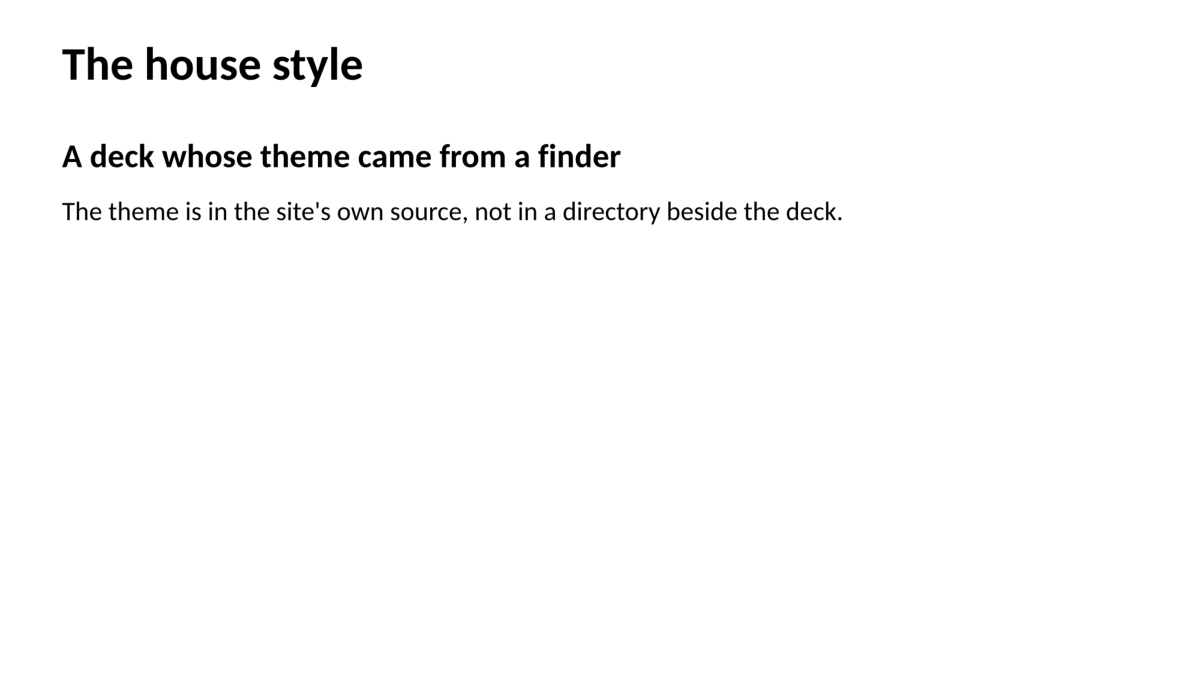
Every example on this page was built by the library it documents while this page was built. This page as Markdown.